HT Syndication
New Delhi [India], September 9: A higher return is often the first thing investors look for. Yet the final amount also depends on how much they invest and how long the money stays invested. Changing either can make a substantial difference without changing the assumed return.
There is no universal winner among these three factors. Their influence depends on the starting figures and the size of each adjustment. A compound interest calculator helps compare them, provided you change one input at a time.
Understand how the three factors interact
For a one-time investment with annual compounding, the relationship is:
Future value = Investment amount × (1 + Annual return)^Years
The annual return is expressed as a decimal, so 8% becomes 0.08. The formula assumes that returns remain invested, with no additions or withdrawals.
The investment amount determines the starting base. The return determines how that base changes each year. Time determines how many years of compounded growth are included.
These factors interact. An extra year applies the assumed return to the amount accumulated by then. A higher return affects every year in the projection. A larger initial investment increases the base across the entire period.
Compare one starting point with three alternatives
Consider Priya, a 34-year-old product designer assessing a ₹3 lakh investment for a future home renovation. Her initial planning period is ten years, using an illustrative annual return of 8%.
She tests three alternatives: investing ₹60,000 more, allowing two additional years, or increasing the return assumption by two percentage points.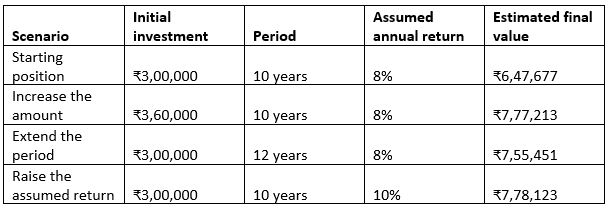
All figures assume annual compounding, no additional contributions or withdrawals, and no separate deductions or inflation adjustment.
The figures shown are for illustrative purpose only
In this comparison, the higher return assumption produces the largest final value, narrowly ahead of the larger investment. However, the adjustments are not equivalent: the amount and duration each increase by 20%, while the assumed return rises from 8% to 10%. The results show the effect of these specific changes, rather than establish which factor always matters most.
Increasing the amount has a proportional effect
Priya’s additional ₹60,000 increases her initial investment by 20%. With the period and assumed return unchanged, the estimated final value also rises by 20%.
This proportional relationship makes the contribution amount straightforward to assess. Doubling the initial amount doubles the projected final value under identical assumptions.
However, the larger balance includes extra money Priya contributes herself. It should not all be described as additional investment growth.
The practical question is affordability. Increasing the amount is useful only if the money is available after accounting for other commitments. A calculator cannot determine how much room exists in a household budget.
Extra time can increase the value without extra capital
Extending Priya’s period from ten to twelve years raises the estimate by approximately ₹1.08 lakh without increasing her initial contribution.
The additional growth comes from applying the assumed return for two more years to the accumulated value. This differs from the larger-investment alternative, which requires extra capital upfront.
Time also has a practical constraint: the date when the money is needed. Postponing an optional renovation may be possible; other expenses may have firmer deadlines.
For an SIP, extending the contribution period also adds instalments. A mutual fund return calculator should therefore show total contributions separately from estimated growth, so the effect of additional money remains visible.
A higher return matters, but remains an assumption
Moving from 8% to 10% is an increase of two percentage points. Repeated over ten years, that change adds approximately ₹1.30 lakh to Priya’s projected value.
The figures shown are for illustrative purpose only
Unlike an additional contribution, the higher return cannot be arranged by changing a calculator input. Mutual fund returns depend on investment performance and vary over time.
A compound interest calculator illustrates the result of an assumed rate. It does not identify a scheme that will deliver that rate. Selecting investments also requires considering their risk and suitability for the intended holding period.
The calculator is an aid, not a prediction tool. It may provide only an indicative picture.
Turn the comparison into a practical decision
Use a mutual fund return calculator to examine adjustments that are realistic for your circumstances. Start with the amount available and the date you need it, then test different return assumptions.
If the estimate falls short, compare an affordable contribution increase with any flexibility in the deadline. Keep the funding requirement visible rather than resolving it only through a higher assumed return.
The most useful outcome is understanding which change you can make, what it costs in money or time, and how much of the result still depends on future performance.
Mutual Fund investments are subject to market risks, read all scheme related documents carefully.
(ADVERTORIAL DISCLAIMER: The above press release has been provided by HT Syndication. ANI will not be responsible in any way for the content of the same.)